
If you have no hot water from your boiler, it can be both frustrating and worrying, especially during colder months when you rely on it the most. Before you call for professional help, there are a few simple and safe checks you can carry out yourself. These steps will help you quickly identify whether the issue is something you can fix by adjusting settings or if it’s a fault that requires a qualified Gas Safe engineer. Following these checks can save you time and help get your hot water back on sooner.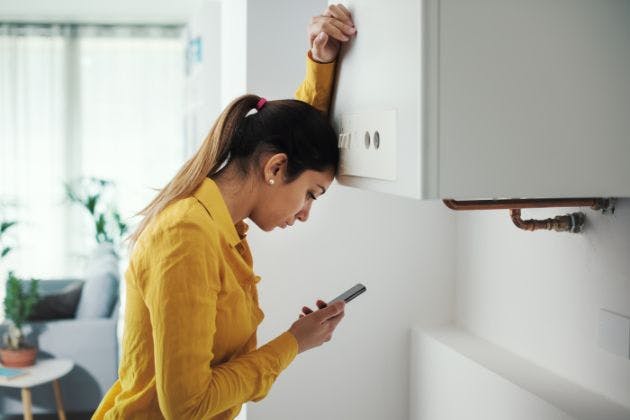
Start with a quick safety check
Before you touch any controls, take a moment to check for anything that suggests a serious fault. If anything below applies, do not keep trying the boiler.
Smell of gas near the boiler, gas meter or pipework
The carbon monoxide alarm is beeping or showing a warning
Visible leaks from the boiler casing or pipe joints
Loud banging or popping when the boiler tries to run
Stop and call a Gas Safe engineer immediately if you notice any of these, and follow the Gas Emergency advice for gas smells. Do not attempt to reset the boiler or remove any covers yourself.
Step 1: Check if your heating still works
First, work out whether you have lost hot water only or both heating and hot water. This can point your engineer in the right direction and help you follow the right branch of the decision tree.
Turn the room thermostat up and set the programmer or timer to call for heating. If some radiators heat up but taps stay cold, that suggests a problem with the hot water side, such as a cylinder control issue or a diverter valve fault on a combi boiler.
Step 2: Confirm basic controls and settings
It is surprisingly easy for controls to be changed without anyone realising, especially if you have guests, children or a complex programmer. Spend a minute double-checking the basics.
Is there power to the boiler and controls (no tripped fuse or switched off spur)?
Is the hot water on your programmer set to On or Continuous, not Off?
Is any hot water thermostat (on the cylinder or combi front panel) turned up enough, usually above 50 °C?
If changing a setting brings the hot water back within a few minutes, keep an eye on it. If it drops out again, note what happened and mention this when you speak to an engineer.
Step 3: Check boiler mode and hot water priority
Some boilers and control systems have different modes for heating and hot water. On combi boilers, you may see options such as Hot water only, Heating & hot water or Eco.
Make sure the boiler is not accidentally set to a mode that restricts hot water. If you have a hot water cylinder, check that the cylinder timer is aligned with when you actually use hot water, not just the heating schedule.
Step 4: Look at system pressure (for sealed systems and combis)
If you have a combi boiler or a sealed system with a pressure gauge, the pressure is usually meant to sit around 1.0 to 1.5 bar when the system is cold. Your boiler manual will give the exact recommended range.
If the gauge is close to 0 or in the red, the boiler may lock out and stop producing hot water. Many boilers also show a low pressure fault code. Topping up with the filling loop is a simple job in theory, but it is easy to overfill or hide a leak.
Do not top up if you are unsure, the gauge is fluctuating rapidly, or you can see any water leaks. In these cases, close any obvious isolation valves below the boiler if you can do so safely, then call a Gas Safe engineer.
Step 5: Pilot light, ignition and flame issues
Modern boilers use electronic ignition rather than a permanent pilot light, but the principle is similar. If the burner will not light or keeps cutting out, the boiler will stop producing hot water.
Look through the viewing window if your boiler has one. On some older models, you may be able to see whether the pilot is lit. Never remove the case or attempt to manually relight any part of the boiler unless the manufacturer specifically explains how in the user handbook, and you feel completely confident.
If the boiler clicks repeatedly, tries to light and then fails with a fault code, make a note of exactly what you see and hear, then switch it off at the controls and arrange a repair.
Step 6: Condensate pipe problems in cold weather
Condensing boilers produce waste water that runs outside through a plastic condensate pipe. In freezing conditions, this pipe can ice up, causing the boiler to shut down and often display a specific fault code.
Typical signs include the boiler trying to start, then stopping with a gurgling sound, and no hot water or heating. The external pipe may look white with ice, or you may hear water backing up.
Some light thawing methods are described in boiler manuals, but these involve working outside with water near pipework, which can be risky in icy conditions. If you are not confident or the boiler trips again after you manage to clear it once, call a Gas Safe engineer for a proper fix and insulation advice.
Step 7: Fault codes and warning lights
Most modern boilers show fault codes when something is wrong. These can relate to low pressure, flame failure, fan problems, sensor faults and more. They are there to help engineers diagnose the issue more quickly.
Write down the exact code, any flashing symbols, and what the boiler was doing just before it stopped working. If the boiler panel lets you scroll through recent errors, take note of those too.
Stop and call a Gas Safe engineer if the same fault code returns after a reset, or if the manual warns that the code must only be handled by a qualified person.
Step 8: Diverter valve symptoms on combi boilers
On a combi boiler, the diverter valve directs heat either to your radiators or to your hot water. If it sticks or fails, you may find that you have heating but no hot water, or the hot water temperature goes hot and cold.
Other signs include radiators warming up when you run a hot tap or needing to open more than one tap to get any heat in the water. These issues are internal to the boiler and are not something to open up or lubricate yourself.
Note the exact behaviour of taps and radiators and pass this information on to your engineer. A trained Gas Safe engineer can test and replace the valve safely.
Step 9: When a boiler reset is reasonable
Most boilers have a reset button or sequence on the front panel. Using this once can sometimes clear a one off glitch after a brief power cut or similar event, provided there are no smells, leaks or alarming noises.
Follow the reset instructions in your user manual carefully and only press reset once. If the boiler runs normally afterwards and there are no further issues, simply keep an eye on it over the next day or two.
Stop and call a Gas Safe engineer if you need to reset more than once, the same fault code keeps returning, or the boiler cuts out again soon after starting. Repeated resets can mask an underlying fault and should not be used as a long term fix.
Information to have ready when you call
Sharing clear details when you book a boiler repair helps your engineer bring the right parts and solve the problem faster. Take a moment to gather the following before you pick up the phone.
Boiler make and model (usually on the front or inside the flap)
Any fault codes or flashing lights and what the display shows
Current system pressure reading, if your boiler has a gauge
A short description of the symptoms, including whether heating works
Mention anything you have already checked from the steps above and any safety concerns you have noticed. This helps the engineer triage the fault and advise you on what to do while you wait.
Next steps for homes in Milton Keynes, Newport Pagnell and Bletchley
If you are still without hot water after these checks, it is time to bring in a professional. An experienced Gas Safe engineer can safely test gas pressures, internal components and flues, which are not DIY jobs.
For reliable boiler repair in Milton Keynes, Newport Pagnell and Bletchley, you can book a visit with B.Brill Plumbing & Heating LTD. Visit our boiler repair service page to request an appointment or call us on 01908410370 to speak to the team.
Regular servicing helps catch many no hot water boiler issues before they interrupt your day, from blocked condensate traps to failing sensors. If it has been more than a year since your last boiler service, ask about booking a service alongside your repair so your system is checked over properly for the seasons ahead.